
When tens of thousands of people gather to see one of the world’s biggest artists perform, concertgoers may only notice security staff at the entrance or around the venue. In reality, the work of keeping a major event safe begins months earlier. Long before the first guest walks through the gates, risks have been assessed, operational plans developed, teams assembled and dozens of potential scenarios carefully considered.
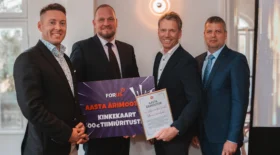
It was this behind-the-scenes work that earned Forus’s Live Nation Estonia major concert security team this year’s Business Engine of the Year award. The recognised team included Kalev Ints, Head of the Southern and Western Regions; Andre Eding, Security Manager for the Western Region; Marko Kangust, Project Manager; Priit Pärgmaa, Head of Short-Term Security Services; and Tõnis Sõõrumaa, Member of the Supervisory Board of U.S. Invest.
While the award belongs to the entire team, Pärgmaa and Kangust offer a closer look at what it takes to prepare for and secure concerts of this scale.
A major opportunity – and little time to prepare
According to Pärgmaa, the partnership with Live Nation Estonia represented an important opportunity for Forus and one the company had worked towards for years. “Working with Live Nation Estonia was something we had been aiming for for a long time. At the right moment, several circumstances simply came together,” he says.
Once the opportunity arose, however, Forus had only a short time to assemble the team and prepare the entire project for delivery. “Projects of this scale would normally have a much longer preparation period. Events like these are not put together in just a couple of months,” Kangust says. “Looking back, it almost seems unbelievable that we managed to get everything ready in time.”
Looking back, it almost seems unbelievable that we managed to get everything ready in time.
The preparations involved far more than simply recruiting security personnel. At the same time, the team had to define operational procedures and areas of responsibility, coordinate with partners and work through dozens of details that would ultimately need to function seamlessly on the day of the concert.
An additional challenge was that preparations for the major concerts coincided with several other large-scale projects. “Rally Estonia and a number of other major summer events were taking place at the same time. That meant we had to plan both our people and our resources extremely carefully,” Pärgmaa explains.
Every detail matters
By the time the first concertgoers arrive at the gates, much of the security team’s work has already been done. Ahead of an event, the team analyses the specific characteristics of the venue, crowd movement and access routes, as well as any potential bottlenecks or risk areas. At an event of this scale, there is no room to rely on solutions being improvised once people are already on site.
Preparations involve not only the organiser and security provider, but also the police, rescue services and other partners. Before major events, the different parties conduct joint tabletop exercises in which potential scenarios are worked through and responsibilities agreed in advance. “The amount of preparation required for events of this size is enormous, and its importance cannot be underestimated,” Pärgmaa emphasises. “Risks have to be identified and mitigated in advance. We need to know exactly how to respond in both routine and emergency situations.”
It is a little like organising a wedding. The guests have no idea how many months of preparation went into it. They simply arrive and enjoy the evening.
According to Kangust, the best security work is often the kind visitors barely notice. The greatest compliment is when people can enjoy the entire evening without ever having to think about security. “It is a little like organising a wedding,” he says. “The guests have no idea how many months of preparation went into it. They simply arrive and enjoy the evening.”
Business Engine of the Year is a team achievement
Pärgmaa and Kangust stress that Forus’s Business Engine of the Year recognition does not belong to them alone. Delivering a project of this scale required contributions from a large number of people across the entire company. “There were many people behind this – from recruitment and HR to technicians, security staff, the control centre and management,” Pärgmaa says. “Projects like these are never the work of just one person.”
He describes the preparation and delivery of the major concerts as a period in which the whole company came together around a shared goal. It required significant additional effort, but it also demonstrated how quickly and effectively the Forus team can mobilise when needed.
For Kangust, the most rewarding aspect of the recognition is precisely that the contribution of the wider team was acknowledged. “At the end of the day, we were simply doing our job,” he says. “But when that work is noticed and appreciated, it feels very good.”