

Forus and the Estonian robotics company Rollo Robotics have signed an official cooperation agreement to jointly develop the use of autonomous patrols in security services. Following the testing carried out so far, the cooperation is now moving into the next stage, with the aim of making the 1ROLLO robot a functional part of a client’s comprehensive security solution.
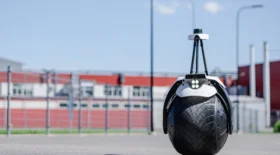
According to Guido Ulejev, Security Solutions Portfolio Manager at Forus, autonomous solutions are being adopted increasingly widely around the world, and technological development has reached a point where they can be built into a genuinely functioning service. “With solutions like this, the question is no longer why, but when. The cooperation agreement gives both parties a clear framework and focus for moving forward,” says Ulejev.
According to Mathias Vaarmann, Head of Business Services at Rollo Robotics, cooperation with Forus is an important step in bringing 1ROLLO to the market. “Our goal is to develop a useful, innovative and future-proof product specifically for security companies, so that clients of security services can receive an even higher-quality and more accessible service. Close cooperation with Forus gives us one of the most important inputs for product development — direct feedback from real-life use,” says Vaarmann.
For Forus, closer cooperation means, among other things, that product development updates from Rollo Robotics can reach clients more quickly. Rollo Robotics, in turn, receives daily feedback from Forus on how the robot performs in real-life situations and what else is needed for the service to function effectively.
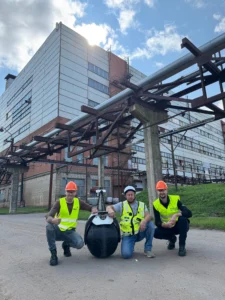
The robot is part of a wider security system
According to Ulejev, testing so far has shown that the value of an autonomous patrol lies not only in the fact that the robot carries out rounds at a site. “The robot is not a standalone device operating somewhere on the site, but one part of the security system. Its value is created when an event detected by the robot quickly reaches the control centre and is followed by the right response,” he explains.
Depending on the needs of the site, different sensors, such as night vision and thermal cameras, can be added to 1ROLLO. The information collected through them makes it possible to respond to events in real time, as well as to analyse data later and identify patterns that can be used to further develop the security solution.
The cooperation so far has also helped Rollo Robotics better understand which tasks an autonomous patrol needs to perform in real-life conditions.
According to Vaarmann, security monitoring is not limited to detecting external threats. “It also includes monitoring employee safety, such as checking the use of protective equipment, detecting potential fire hazards and much more. Based on this, we also choose our development direction so that 1ROLLO technology can detect as many different threats as possible.”
The tests so far have also shown that, in addition to the robot itself, preparation of the site is important. Patrol routes, area mapping, mobile network coverage and the robot’s charging location all need to be considered.
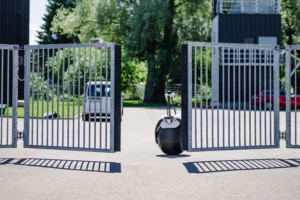
The greatest potential lies in large outdoor areas
Forus currently sees the greatest potential for autonomous patrols in large outdoor areas — for example logistics and production sites, storage yards, ports, terminals, and energy and infrastructure sites.
The robot can carry out night and weekend rounds, check the perimeter and, in the event of an alarm, move to the incident location before a patrol is dispatched. It can also be used in places where installing fixed cameras or other sensors is difficult, or where surveillance is needed only temporarily.
According to Ulejev, the goal is not to replace people with robots. “On the one hand, the robot takes over routine tasks; on the other, it can collect much more diverse data than a person can notice with their own eyes. The human role remains to interpret the overall picture, make decisions and respond where a person is truly needed.”
The autonomous patrol will complement Forus’ existing video surveillance, perimeter security, patrol, manned guarding and control centre services. One new possibility, for example, is checking an incident on site without immediately sending a person to the location, and, if necessary, communicating with a person at the site through the robot’s speaker.
According to Vaarmann, the main winner of the cooperation is ultimately the client. “They receive a higher-quality, more efficient service with broader coverage, which is more cost-effective than today’s solutions.”
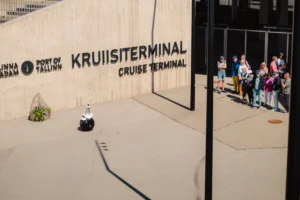
The future of security services is hybrid
Before autonomous patrols can be introduced more widely, several questions related to Estonia’s climate and the structure of the service still need to be solved. In winter, the robot’s movement is affected by snow; in warmer seasons, by tall grass and vegetation; and various weather conditions may affect the operation of sensors. Data exchange between the robot and the Forus control centre, as well as automated analysis, also need to be further developed.
Ulejev nevertheless believes that in a few years, autonomous patrols in large outdoor areas may become as natural a part of a security solution as video surveillance is today. “The future of security services is hybrid: technology performs repetitive and measurable work, while people make decisions and respond. The robot does not replace other layers of security, but makes it possible to complement them and connect them better than before.”
Rollo Robotics sees similar potential. “Our vision is that autonomous patrols will become a standard part of the broader service package that security companies offer their clients. If in a year or two Rollo robots can already be found at several Forus client sites, we can say that we have truly succeeded,” says Vaarmann.