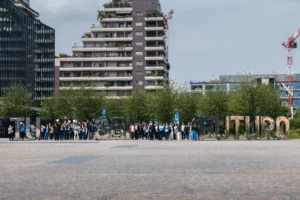

Jaanika Veldre, Head of Sustainability in Real Estate at Forus, recently attended the GBCI Europe Circle 2026 conference in Milan, where leading experts gathered to discuss the future of sustainable real estate in Europe. This year’s central theme, “Forging Resilience,” focused on how cities, buildings, and businesses can adapt to a world that is becoming increasingly unpredictable.

For Veldre, the conference highlighted a major shift in how the industry approaches sustainability. “Many things that were still considered ambitious goals just a few years ago have now become the baseline,” she says.
According to Veldre, the conversation in Europe is no longer centered around whether sustainability measures should be implemented, but rather around how to create greater long-term value through them. “A nearly zero-energy building? That’s already considered standard. Building lifecycle analysis? The question is no longer whether to do it, but what to do with the knowledge afterward,” she explains.
She also points to LEED v5 — the latest version of one of the world’s most recognized green building certification systems — as a sign of how priorities are evolving beyond energy efficiency alone. “The focus is increasingly on human wellbeing, climate risk management, and the building’s overall impact on the environment,” says Veldre.
Sustainability is becoming the new normal
The conference discussions covered topics such as decarbonization, sustainable finance, climate risks, and the future of green building certifications. One message remained consistent throughout the event: sustainability solutions should no longer be viewed as optional extras or added value, but as a natural part of every development project.
Veldre says the Italian market demonstrates particularly well how deeply this mindset has already taken root elsewhere in Europe. “There is no longer any debate about whether a building should be certified. It’s as obvious as the fact that a building needs a roof,” she says.
In her view, Estonia is moving in the same direction, although the mindset still lags behind some European markets. “This is not criticism — it’s simply where we are today,” she notes.
At the same time, Veldre sees encouraging signs of progress outside Tallinn as well, with more certified developments emerging in cities such as Pärnu, Haapsalu, and Tartu.
Bringing more nature into cities
One of the strongest impressions Veldre took away from Milan was the emphasis placed on greenery and integrating nature into urban environments. “Tallinn is still, in many ways, quite a concrete city,” she says. “It’s great to see that newer developments are increasingly focused on creating more enjoyable and people-friendly urban spaces.”
Although Southern European architectural solutions cannot always be directly adapted to Estonia’s climate, Veldre believes the broader way of thinking is highly relevant.
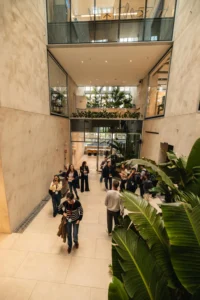
She recalls visiting a building in Milan where a glass-roofed indoor botanical garden had been created between two buildings — a solution designed entirely around people and quality of space. “Not everything can be replicated in Estonia due to climate conditions, but the ideas themselves encourage us to think differently about what urban environments could be,” she says.
According to Veldre, Estonia could also do much more to bring nature into city spaces.
Seeing the bigger picture
For Veldre, participating in international conferences is important because it offers more than statistics or trend reports — it provides direct insight into how people across Europe are approaching the same challenges. “One thing is reading news and statistics. Another is actually speaking with people face to face,” she says. “The concerns and challenges are surprisingly similar everywhere.”
The GBCI Europe Circle conference brought together consultants, developers, investors, bankers, technology providers, and property owners from across Europe.
For Veldre, the event reinforced the idea that green certifications are far more than paperwork. “They are frameworks that help push the entire sector toward thinking differently,” she says. “For a long time, many solutions in the industry have been fairly copy-paste. Now the question increasingly is: how can we do even better?”