
Patrol officer Aleksandr Rõžov, who received this year’s Forus Act of the Year recognition, believes that in a critical situation the most important things are a calm mind and the ability to act step by step. This was exactly the approach that helped him save a person’s life last year, when, while patrolling in Jõhvi near Jewe Keskus, he noticed an unconscious person and immediately began resuscitation.
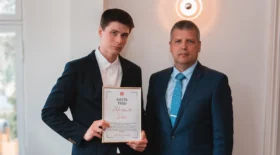
Aleksandr’s quick and professional actions did not go unnoticed outside the company either – the Estonian Security Association (ETEL) highlighted him as a nominee for Security Officer of the Year, emphasizing his rapid response and ability to make the right decisions in a critical situation.
He came to Forus because he wanted to do meaningful work
Aleksandr was born and raised in Jõhvi. After upper secondary school, he began studying at the Rescue College with the aim of becoming a rescuer. However, a knee injury forced him to discontinue his studies, and later a recurring meniscus injury also made him give up his previous job. “Rescue work requires a very high level of physical effort, and I no longer wanted to risk my knee or return to the rescue field,” he says.
When his health allowed him to return to work, Aleksandr looked for an opportunity to do something just as varied and meaningful. He contacted Artjom Troitski, Head of Patrols in Ida-Viru County, who offered him the opportunity to start working in the Kiviõli patrol. In December 2023, Aleksandr joined Forus, and just a few months later he continued working in his home area, Jõhvi. “I still wanted to do interesting and varied work, and Forus gave me that opportunity,” says Aleksandr.
According to Aleksandr, the biggest characteristic of patrol work is its unpredictability. “The working day is quite varied and depends a lot on what calls come in during the day,” he explains. “We respond to different calls, carry out rounds at sites and complete tasks received from the control centre.”
Although most working days pass calmly, sometimes difficult situations also need to be resolved. “With a panic alarm, you never know in advance what is waiting for you on site. That is why you always have to be ready for very different situations.”
Timely response saved a person’s life
Last summer, Aleksandr was patrolling in Jõhvi as usual when he noticed a person lying on the ground near Jewe Keskus, with bystanders gathered around. “When I reached the person, I saw that his face was already bluish, and there was no pulse or breathing,” he recalls.
Aleksandr immediately began chest compressions while bystanders called an ambulance. “After a few minutes, the person’s facial colour started to return to normal.”
More and more people gathered at the scene and tried to help in their own way. “Someone even tried to lift the person’s legs, but I immediately said that there was no need to do that,” says Aleksandr. “The most important thing was to continue chest compressions.” He continued resuscitation until the ambulance arrived.
Later, when reviewing the security camera footage, it became clear that the person had lost consciousness about a minute before Aleksandr drove past him. “That meant help reached him very quickly, and that fast response played a very important role.”
Calmness comes from knowledge and accumulated skills
Aleksandr admits that although this was the first time he had to resuscitate a person in real life, he did not panic. “I had no previous real-life experience of resuscitation, but in that situation, the knowledge and skills I had gained in first aid training helped me.”
He says there was no time for emotions in a critical situation. “I focused on the fact that the person needed help here and now. In a situation like this, I have no time for panic. I act step by step and do what I know how to do,” says Aleksandr.
That is why he considers a calm mind, attentiveness and the ability to make quick decisions the most important qualities in patrol work. “Any situation can change within seconds, and you have to stay in control and act with confidence.”
Recognition for the work done
Aleksandr says he does not consider what happened to be a heroic act. “For me, it was nothing heroic. It was simply a normal day on patrol, and situations like this can happen in our work,” he says.
At the same time, Aleksandr is pleased that such actions are noticed. “It is good to know that this kind of act is noticed, and it shows me that I acted correctly,” he confirms.
In his everyday work, he is motivated by the knowledge that no working day is the same as the previous one. “What I like most is that my work is varied and no two days are exactly the same. I also have a very good security manager who supports and motivates the team.”
In his free time, sport, walks in the fresh air and travelling help him switch off from work. Last year, he travelled to Italy with a friend to watch football, and he also values Forus’ flexible work schedule, which allows him to plan his free time better.
For those who want to succeed in patrol work, Aleksandr has a simple recommendation: “Stay as calm as possible and assess the situation before acting. In a critical situation, it is always important to first think about your own safety and the safety of your colleague. If possible, call for help quickly and act step by step according to the situation.”
***
Forus’ strength lies in the people who give their best every day for our customers, colleagues and the company as a whole. That is why each year we recognise employees whose dedication, professionalism and exemplary work have stood out in a special way. This year, we once again selected Forus’ best employees across eleven different categories. Through their attitude, actions and cooperation, these people inspire our entire team. Congratulations and a big thank you to everyone who received this recognition!
Together, we create a safe and sustainable environment. Join the Forus team and make your valuable contribution! You can find more information and contact forms on the Forus website.