

Many homes, summer houses, garages and businesses have a fire extinguisher, but people often do not know when it was last inspected or whether it would actually work in a fire. Ahti Kuusk, Head of Safety Services at Forus, explains what to look out for and why simply having a fire extinguisher is not enough.
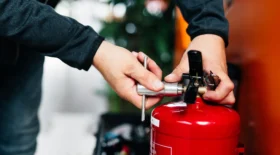
When it comes to fire extinguishers, the expiry date is not the only thing that matters. What is more important is whether the extinguisher has been regularly inspected, properly maintained and is ready for use.
A fire extinguisher may look perfectly fine on the outside, but that does not necessarily mean it will work when needed. Over time, its condition can be affected by a loss of pressure, moisture, temperature fluctuations, corrosion or physical damage. That is why extinguishers need regular visual checks, professional inspections and maintenance when required.
A visual check should be carried out every three months to make sure the extinguisher is in the correct location, easily accessible and free from visible damage. If it has a pressure gauge, the needle should be in the green zone. The safety pin and tamper seal should also be intact. A missing seal, particularly on a CO₂ extinguisher, may indicate that someone has used it.
As a general rule, fire extinguishers kept in a dry environment with a stable temperature must be professionally inspected every two years. If they are exposed to moisture, vibration or temperature fluctuations, inspections are required annually. Maintenance is necessary after every use, as well as every five years for water and foam extinguishers and every ten years for other types.
The same principle applies at home: if you have a fire extinguisher, it must be in working order and readily accessible. This is particularly important in summer houses, garages, sheds and vehicles, where extinguishers may be exposed to moisture, dust, vibration or significant temperature changes.
How can you tell if your fire extinguisher may be faulty?
Start by checking the inspection or maintenance label. It should show when the extinguisher was last inspected or serviced. If the label is missing, illegible or indicates that a long time has passed since the last inspection, it is worth having the extinguisher checked by a professional.
If the extinguisher has never been serviced, check the month and year of manufacture marked on its body. This is also something to pay attention to when purchasing a new extinguisher.
Next, examine its overall condition. Warning signs include:
-
A rusty or dented cylinder
-
A damaged hose
-
A missing tamper seal or safety pin
-
Illegible operating instructions
-
A pressure gauge reading outside the green zone
An extinguisher showing any of these signs should not be considered a reliable safety device.
If an extinguisher has been dropped, suffered an impact, been stored in damp conditions or seems questionable for any other reason, it should be inspected. When a fire breaks out, there is no time to find out whether the extinguisher works.
Can you reuse a fire extinguisher if only a small amount has been discharged?
Once a fire extinguisher has been used, it must be inspected again and refilled or serviced if necessary. It should not simply be put aside in the hope that it will still be sufficient next time.
When a fire breaks out, there is no time to find out whether the extinguisher works.
Even limited use may affect an extinguisher’s reliability or leave it without enough extinguishing agent for the next emergency. Every second counts during a fire, and a partially used extinguisher can create a false sense of security.
Where should you keep a fire extinguisher?
A fire extinguisher must be stored somewhere it can be reached quickly. Keeping it behind a cupboard, in the far corner of a garage, inside a storage room or anywhere that may become inaccessible during a fire is not a good idea.
At home or in a summer house, the extinguisher should ideally be visible and located along a commonly used route, for example near the kitchen, entrance, garage or sauna, depending on where the greatest risks are. Everyone in the household should know where it is and how to use it safely.
The same applies to businesses. Employees should know where extinguishers are located and who knows how to use them. An extinguisher will be of little help in an emergency if boxes, furniture or goods are blocking access to it.
Which fire extinguisher should you choose for your home or summer house?
There is no single answer, as the right extinguisher depends on the risks involved.
Powder and foam extinguishers are commonly used in homes and summer houses. Powder extinguishers are widely available and suitable for many types of fire, but the powder can cause considerable additional damage indoors. Foam extinguishers may be a more practical option for domestic use, although it is always important to check which fire classes a particular extinguisher is designed for.
Kitchens and barbecuing areas require special attention because of the risk of cooking oil and fat fires. Never use water to extinguish a cooking oil or fat fire, as it can cause burning fat to spread. A Class F fire extinguisher or a fire blanket is suitable for this type of risk.
The risks may be different in garages, workshops and business premises, where electrical equipment, fuels, tools and other materials may be present.
What are the most common mistakes people make with fire extinguishers?
The most common mistake is buying a fire extinguisher and then forgetting about it. People assume that simply having one means they have taken care of fire safety. In reality, an extinguisher must be the right type, in good working order, easy to access and familiar to the people who may need to use it.
Other common mistakes include:
-
Not checking the inspection or maintenance date
-
Keeping the extinguisher hidden or blocking access to it
-
Not knowing how to use the extinguisher
-
Leaving it in damp or cold conditions for years
-
Putting a partially discharged extinguisher back on the wall
-
Attempting to extinguish a cooking oil or fat fire with water
-
Assuming that a very old extinguisher will still work
What should you check on your fire extinguisher today?
A simple visual check should cover the following:
-
Is the inspection or maintenance label legible?
-
Is the pressure gauge needle in the green zone?
-
Are the tamper seal and safety pin intact?
-
Is the cylinder undamaged and free from rust?
-
Are the hose and nozzle in good condition?
-
Are the operating instructions legible?
-
Is the extinguisher visible and easy to reach?
-
Does everyone know where it is and how to use it?
A good habit is to check your fire extinguisher at least once a year, as well as before periods of increased risk, such as the start of summer, Midsummer celebrations, the beginning of the heating season or before reopening a summer house for an extended stay.
Want to make sure your building’s fire safety measures are in good condition and suited to the actual risks? Learn more about Forus fire safety consultation services and contact our specialists.