Forus in-house trainer Jaak Kivimäe has worked in the security industry for more than 30 years. During that time, companies, working methods, technology and generations have changed. Yet one thing, he says, has remained the same: when faced with a real-life situation, people must ultimately know how to act independently. Outside his work in security, Jaak has another world that has been part of his life for decades – yoga and journeys to remote mountain villages in India.
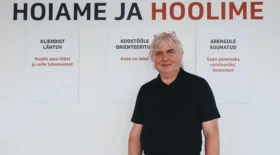
Ask Jaak to introduce himself without mentioning his job title, and he quickly returns to the reason he is still working in security after all these years.
“I’m someone who remains passionate about the security industry. I enjoy finding ways to bring real-life situations into training,” he says.
Jaak began his career in security back in 1993. Over the years, mergers and changes in company ownership have taken him from one organisation to another. He also spent some time running his own training company, but he has never really left the security industry.
For Jaak, the role of a security officer can be explained quite simply: they stand between the property being protected and a potential threat. Technology can provide increasing support, but he does not believe it can ever fully replace people.
“You could be sitting in the Canary Islands watching a live 5K video feed of someone stealing insulation boards from your construction site. But ultimately, you still want someone to physically intervene.”
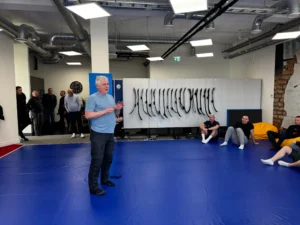
Training must prepare people for real-life situations
Jaak has witnessed very different attitudes towards training over the years. There have been times when employee training was the first expense companies chose to cut, and others when its value was more widely recognised.
One thing is clear to him: online courses and independent learning can support the training process, but they cannot fully replace face-to-face teaching in a classroom.
A security officer must be able to apply their knowledge when their heart is racing, another person may be acting aggressively and there is little time to make a decision. That is not something that can be learned simply by sitting comfortably at home in front of a screen.
Jaak gives the example of employees preparing for an examination. Someone may know all the answers at home, but the real question is whether they can recall that knowledge when standing in front of another person and having to respond immediately.
“That’s your working environment. You have to be able to access the right knowledge in a relatively stressful situation.”
A security officer must be able to apply their knowledge when their heart is racing, another person may be acting aggressively and there is little time to make a decision.
This is why Jaak does not limit his courses to theory. He gives participants as many opportunities as possible to practise real-life scenarios.
A good security officer does not look for conflict
What kind of person is suited to working in security? Jaak starts with something quite simple: they have to want to do the job. In his view, salary alone is not enough to keep someone motivated in the long term.
“You have to be interested in this field. And, incidentally, that’s the only reason I’m still here.”
At the same time, a good security officer does not necessarily have to be the most forceful or loudest person in the room. According to Jaak, one of the most important objectives of security work is actually to de-escalate situations.
Someone who enjoys dominating others and engaging in conflict may eventually become part of the problem. Equally, security work can be challenging for someone who is extremely afraid of confrontation, even if it is only verbal or psychological.
Jaak also values attentiveness, the ability to learn and the skill of reading people and situations.
During his courses, he has repeatedly seen how someone who initially appears very quiet and reserved can turn out to be surprisingly capable. An introvert may not say much during training, but a later conversation often reveals that they have been paying close attention throughout.
Sometimes, the greater challenge is retraining someone who has spent years thinking, “This is how we used to do things.”
Staying calm takes practice
One topic Jaak always tries to add to formal training materials is psychology. For example, the first instruction in a guide to handling conflict may simply say: stay calm.
“My question is always: but how? What do you do if staying calm doesn’t come naturally to you?” Jaak asks.
According to him, self-control cannot simply be switched on when someone tells you to remain calm. It must be practised until a person can draw on the right techniques in a stressful situation almost instinctively.
The same principle applies to many other skills required in security work. Hearing about something once is not enough. People need to rehearse situations, try different approaches and experience them for themselves.
And this brings us to Jaak’s “other world” – the source of some of his own calmness, attentiveness and ability to approach stressful situations with a clear mind.
A profession versus a calling
“I have a profession, and I have a calling,” says Jaak.
For him, a profession is what someone does for work. A calling is something different – something they feel consistently drawn towards, even when their enthusiasm temporarily fades.
In Jaak’s case, that calling is yoga.
He first discovered yoga in the early 1980s through karate. During the Soviet era, these teachings circulated mainly within small groups, but they gradually gave him a growing sense that there was something more to physical training.
Today, yoga is a natural part of Jaak’s everyday life. He usually gets up at six in the morning and practises yoga with his wife for an hour to an hour and a half. In the evening, he may spend another hour and a half to three hours practising.
“For me, yoga is nothing more than the study of nature,” Jaak says.
By this, he means understanding how people and nature function, as well as developing awareness and presence.
Jaak offers a familiar example: you might be sitting in a meeting, looking directly at the person speaking, while actually thinking about things you need to do at home. Physically, you are present, but mentally you are somewhere else.
According to him, genuine understanding only becomes possible when your attention, mind and actions are all focused on the same thing.
The same principles of presence and balance apply directly to security work.
For Jaak, balance does not mean living without problems or becoming completely unaffected by everything around you.
“Balance doesn’t mean the absence of problems. It can mean being able to remain calmer even when you’re surrounded by them.”
Nor does this guarantee that difficult situations will always end well.
“Not always,” he replies when asked whether a person should somehow emerge victorious from every crisis.
Rather, practice can help someone accept difficult situations more readily and maintain greater calmness and clarity while experiencing them.
When asked whether he has ever considered making yoga his main occupation, his answer comes quickly:
“My work is also my yoga.”
Jaak does not see his work and yoga as two strictly separate worlds. He finds the same attentiveness, creativity and personal growth that he associates with yoga in his work as a trainer.
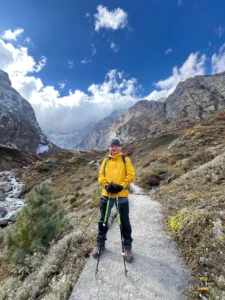
Six journeys to India in ten years
Yoga has also taken Jaak to India on several occasions. He first visited in 2016 and has now made six trips in total.
“I feel at home there,” he says.
His visits to India have primarily been about learning rather than sightseeing.
He has spent most of his time in rural areas and the Himalayas, meeting teachers and studying with them.
“I’ve visited masters. That’s one of the main reasons I’ve travelled there at all.”
He speaks about people with whom he has been able to exchange knowledge and from whom he has received guidance and encouragement.
Some of those experiences always find their way back into the Forus training room, particularly his willingness to adapt training to the people sitting in front of him.
Rather than giving everyone the same exercise simply because it is prescribed, Jaak tries to find the most practical, relatable way to help participants understand and apply what they are learning.
When time allows, he also talks about sleep, rest and daily routines during his training sessions.
These may seem like simple things, but he believes they directly affect people’s readiness to act and their overall wellbeing.
How can you find your own calling?
When asked what the security industry could learn from yoga, Jaak once again returns to balance.
“How to be calmly active and actively calm.”
For him, this applies both to security work and to life more broadly – finding a balance between effort and rest, responsibilities and the things that genuinely matter to us.
Jaak returns to the same idea when discussing how people might discover their own calling.
He recommends starting with a very simple question: What do I want?
Then ask yourself: Why?
And, if necessary, return to that same question several more times.
“Sometimes you have to ask yourself the same question five or ten times.”
The deeper you go, the more important it becomes to be honest with yourself, he says.
The first answers may be relatively superficial, but by continuing to explore them, you may eventually discover what you truly need.
If you are interested in a career where attentiveness, readiness and the ability to act in real-life situations matter, explore career opportunities at Forus and apply.