Two Forus security experts helped organise security for a concert by world-famous singer Shakira in Bishkek, the capital of Kyrgyzstan. Priit Pärgmaa and Kristo Konks, who were brought into the project by Estonia-based Baltic Music Group (BMG), worked alongside the artist's international security team to help ensure the safety of Shakira, her crew and tens of thousands of concertgoers.
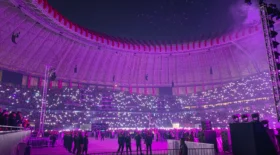
On 18 October, Shakira performed at Bishkek Arena in the capital of Kyrgyzstan as part of her Las Mujeres Ya No Lloran world tour. Priit Pärgmaa, Head of Short-Term Security Services at Forus, and Kristo Konks, Head of Security Services, were involved in preparing the event and organising its security. Their task was to help the organiser meet the requirements of the artist’s security team and coordinate security-related activities on site.
According to Priit, it all started with a phone call from Baltic Music Group asking whether he would be interested in joining a special project in Kyrgyzstan.
“Of course I agreed,” he recalls.
As a first step, he travelled to Kyrgyzstan with representatives of BMG and Shakira to assess whether the concert could be organised. Together, they inspected the venue, hotels and other locations important to the event’s security. After extensive preparations, they concluded that holding the concert was feasible.
International security requirements had to be adapted to local conditions
Priit was involved in the preparations from the very beginning. His responsibilities included assessing security risks, establishing local contacts and aligning international security standards and the artist’s team’s expectations with local capabilities.
“Considering how little time there was between the final decision to hold the concert and the event itself, it was an extraordinary effort from everyone involved. The local teams gave it their all, and we supported them with our knowledge and experience,” Priit explains.
During the preparations, it became clear that additional support was needed, particularly in matters concerning backstage security and the artist’s personal safety. This led to another Forus colleague, Kristo Konks, joining the project.
Priit arrived in Bishkek on 11 October, and Kristo joined him four days later.
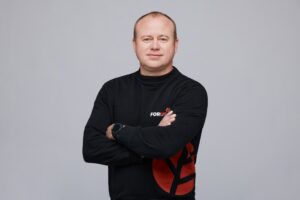
Kristo’s initial responsibility was to organise backstage security in accordance with the artist’s security team’s requirements. This included controlling access points, positioning security personnel and coordinating movement to and from the stage and backstage areas.
As plans were constantly changing, information had to be passed quickly to the local security supervisors, and it was necessary to ensure that agreed arrangements were followed.
“Ultimately, it became a much bigger project than simply providing backstage security. In practice, we helped organise security for the entire event based on the artist’s security team’s requirements. We acted as a link between the different parties, communicating information, planning operations and helping put the agreed arrangements into practice,” Kristo explains.
In addition to their organisational responsibilities, the Forus team helped ensure the safety of Shakira and her crew from their arrival at the airport until their departure from the country.
Local working practices and international security requirements required flexibility
According to Priit, organising security for a major event in Kyrgyzstan was considerably different from what they were accustomed to in Estonia.
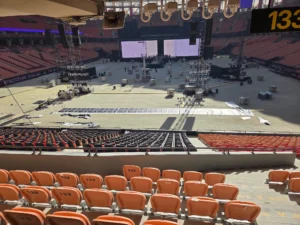
Numerous state security agencies were involved in securing the event, with approximately 2,500 militia personnel deployed for the concert alone.
There were also differences in working practices. For example, it was customary for uniformed personnel to be stationed in the security area between the audience and the stage. However, Shakira’s team’s requirements specified that no uniformed personnel should be present in that area.
“These were the kinds of details we had to discuss on site and find solutions to together. The artist had specific expectations, while the local teams had their established ways of working. Our role was to help bring the two together,” Priit explains.

Kristo also says that the greatest challenge was working with local security units, whose existing approach to managing security at major events differed from the expectations of an international artist’s team.
“At first, the local uniformed officers found it difficult to understand how a global superstar’s security team could make so many security-related decisions themselves. There were so many units on site that we even had to use the concert’s sound system to give them instructions,” Kristo recalls.
Although cooperation between the various parties initially required considerable adjustment, a common approach was eventually established.
“We adapted quickly, and so did the local teams. From the opening song until the artist’s departure, everything ran smoothly,” Kristo says.
Priit emphasises that the contribution of local security personnel and state security units was crucial to the event’s success. Although hosting such a major international star was a new experience for them, they were willing to learn and find solutions.

Kyrgyzstan left a lasting impression
Despite the demanding workload, Priit also has fond memories of Kyrgyzstan itself, a country he had never visited before.
“Extremely friendly and hospitable people, incredibly delicious food and breathtaking nature,” he says, describing his impressions.
The distinctive features of the local security culture were an experience in themselves. For example, Priit remembers how effectively militia officers used whistles to direct large crowds.
Priit believes that Kyrgyzstan will host an increasing number of major international concerts in the future. Along with valuable professional experience, the Forus team established several useful contacts during the project and hopes to work with them again.
Asked what he will take from this experience into his everyday work, Priit gives a brief answer: “Flexibility, patience and humility.”
For Kristo, it was also an exceptional experience, giving him a much broader perspective on organising security at major events.
“This experience gave me insight into practically every position at a major event that I probably hadn’t encountered before. Now it’s difficult to imagine what could still surprise me,” Kristo concludes.
Forus would like to thank Lauri Laubre, the driving force behind Baltic Music Group, for his trust and the opportunity to participate in this extraordinary project.