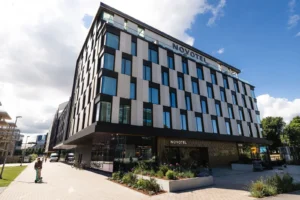

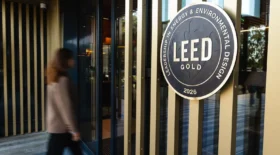
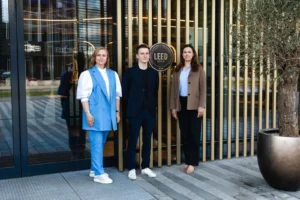
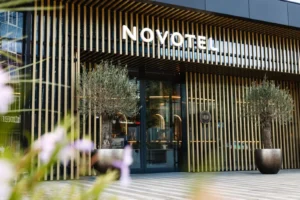
Novotel Tallinn hotel has been awarded the internationally recognised LEED Gold green building certification, one of the world’s most widely acknowledged confirmations of a building’s energy efficiency, environmental performance and user comfort. The building was developed by Estmak Capital OÜ, constructed by NOBE, and the certification process was coordinated by Forus.
According to Tatjana Arhipova, CEO of Estmak Capital, the aim with Novotel Tallinn was to apply the same quality and sustainability standards that the company follows in its residential, commercial and mixed-use development projects. “As the building combines hotel rooms with apartments designed for longer stays, it must function both as an accommodation facility and as a comfortable temporary home. LEED provides an internationally recognised framework for this ambitious approach,” Arhipova said.
According to Jaanika Veldre, Head of Real Estate Sustainability at Forus, this is a landmark achievement, as the hotel sector in Estonia has so far not been represented in LEED certification. “Although other international green certificates have previously been awarded in the Estonian hotel sector, Novotel Tallinn is the first accommodation establishment in Estonia to receive LEED certification. In office and retail spaces, LEED has already been a high-quality standard for many years,” Veldre said.
LEED provides an internationally recognised framework for this ambitious approach.
Compared with an office building, a hotel has a significantly more complex energy balance due to different usage patterns, higher water and energy consumption, and the need to consider the experience of both employees and guests at the same time.
According to Veldre, interest in green certifications is clearly growing in the hotel sector, although it still lags around five to seven years behind the office sector. “At the same time, more and more hotels are no longer limiting themselves to the Green Key label but want an international compliance certification for the entire building. This is also linked to the developer’s own values and financing — green loans offer more favourable terms, and many investors want to see a sustainability plan,” Jaanika Veldre added.
Environmentally sustainable technical solutions
Novotel Tallinn’s energy efficiency is supported by solar panels, energy piles for heating, heat recovery ventilation, underfloor heating, modern cooling systems and water-saving sanitary fixtures. Responsible material choices and the proper management of construction waste also contributed to achieving the certification.
As an innovative solution, the diesel generator has been replaced by a battery energy storage system, which activates immediately in the event of a power outage, reducing both noise and emissions.
According to Arhipova, the principles of LEED are reflected in aspects that guests experience directly. “Air quality, indoor climate, acoustics, lighting and water use are the elements that make being in the building comfortable,” Arhipova said.
Sustainability begins with early decisions
According to Melvin Mugamäe, Project Manager at NOBE, early decisions determine the outcome of a LEED project. “The energy efficiency, technical solutions and user comfort of a sustainable building are established already during the design stage,” Mugamäe said. During construction, this meant more thorough monitoring and documentation of environmental impacts than usual. Specific checklists were prepared and followed to control dust, noise and site cleanliness. According to Mugamäe, sustainability in the construction sector is moving from a special solution towards becoming a standard, and on larger projects, assessing environmental impact is already a natural part of the development process.
The trend is clear: by 2030, certification will probably become as self-evident as an A energy class is today.
LEED certification affects the long-term value and attractiveness of a building for investors, operators and international hotel brands alike. In recent years, the Estonian real estate market has made strong progress in terms of green certification. Over the past five years, 20 new buildings have been certified in Estonia, and in terms of certified square metres, Estonia ranks fourth in Central and Eastern Europe. “The trend is clear: by 2030, certification will probably become as self-evident as an A energy class is today,” Veldre said.
Novotel Tallinn is a four-star hotel located on Poordi Street in central Tallinn and opened in December 2025. The hotel has 132 accommodation units, including hotel rooms and fully equipped apartments designed for longer stays. The hotel is located close to Tallinn’s Old Town, the Rotermann Quarter and the harbour.