Estonian households are using more and more battery-powered devices, from cordless drills, grass trimmers and handheld vacuum cleaners to phones, electric scooters and even smaller gardening tools such as pruning shears. While these devices make everyday life more convenient, they also introduce fire risks that people often overlook, warns Ahti Kuusk, Head of Safety Services at Forus.
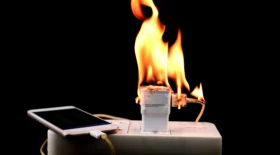
A typical situation is simple: after using a device, someone puts the empty battery on charge and leaves it there overnight. Often, the battery is charged somewhere convenient and out of sight, such as a hallway wardrobe surrounded by clothes and other belongings. According to Ahti Kuusk, habits like these can become extremely dangerous.
More batteries mean greater risks
According to the fire safety expert, battery fire safety is becoming increasingly important because households now contain more battery-powered devices than ever before. People also frequently use batteries and chargers of unknown origin, whose quality and safety cannot always be verified.
“Nowadays, for example, you can order a battery online that is considerably cheaper than the original and promises an exceptionally long operating time. But we have no idea how the product was assembled or what is actually inside it,” he explains.
Kuusk recalls an incident involving a colleague who once tested a battery from an unknown manufacturer. Everything initially seemed to work, but under a heavier load, the situation quickly became dangerous.
“While he was using an angle grinder, the battery became so hot that he quickly took it outside. He almost burned his hand. A little longer and that battery could have caught fire while the tool was still running,” he says.
According to Kuusk, the situation is made more complicated by the uncertainty surrounding the quality and safety of batteries ordered online from unknown sources.
“When you buy a device from an established manufacturer, the manufacturer is responsible for it. But when you order an unknown battery from somewhere, you don’t really know what you’re getting.”

Why do lithium batteries catch fire?
According to Kuusk, the main causes are mechanical damage and overheating.
“I’d like to see a cordless drill or another tool that has never been dropped,” he says. “When a battery suffers an impact, internal damage can occur.”
Components inside the battery may become deformed as a result of an impact, potentially triggering a chemical reaction that leads to ignition.
Another major risk is heat. If a device does not receive sufficient cooling or overheats while charging, the risk of fire increases significantly.
“For example, if a phone is left charging on a car dashboard in direct sunlight, it can overheat very quickly,” Kuusk explains. “Essentially, we’re heating it to a dangerous temperature ourselves.”
Kuusk describes two incidents in which small battery-powered devices suddenly became dangerous. In one case, a flashlight exploded inside a car. In another, an electronic cigarette broke apart in someone’s pocket while they were sitting down, damaging their clothing.
According to him, these examples show that the risks associated with even small batteries should not be underestimated. Damage or a short circuit can trigger an extremely rapid and dangerous reaction.
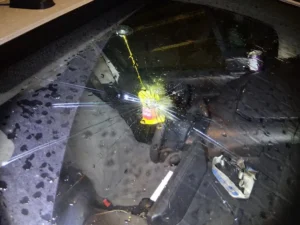
The photo shows a flashlight that exploded while charging inside a car.
According to Kuusk, such incidents demonstrate just how quickly a battery malfunction can become dangerous. People often do not realise how much energy is stored in small batteries or how high temperatures can rise during ignition or a short circuit.
Poor charging habits can create serious hazards
According to Kuusk, people make several mistakes when charging batteries at home, and these can quickly turn a fire into a critical situation.
Batteries are often charged somewhere convenient and out of sight, such as inside a wardrobe.
“If the wardrobe is full of clothes and something catches fire inside, there is a very high fire load,” he explains. “And if the wardrobe is in the hallway near the front door, the fire could also block the only exit from the apartment.”
He stresses that batteries should not be charged inside closed cupboards, under pillows in bed, on sofas or on other soft materials. Leaving devices charging overnight without supervision is also a bad idea.
Kuusk also points out that people often fail to consider how quickly smoke could reach them if a fire starts.
The situation becomes particularly dangerous when batteries are charged in bed, on a sofa or somewhere else close to a person, while the smoke alarm is installed on the ceiling some distance away.
“If the smoke alarm only reacts once the person is already breathing in smoke, it may be too late,” Kuusk warns.
Faulty chargers and cables increase the risk of fire
In addition to the batteries themselves, the condition of chargers and cables plays an important role.
According to Kuusk, people still use broken, worn or temporarily repaired chargers at home. These can affect both the operation of the device and the safety of its battery.
“If a charger is already making crackling noises, it should be replaced. That kind of fault can also start affecting the battery,” Kuusk emphasises.
He also believes people often underestimate the importance of using a charger that is suitable for the device.
Many prefer faster or more powerful chargers, but not every device can handle the charging power they provide.
“Manufacturers specify which charging power should be used. If you connect a charger that is too powerful, the device may not support it at all,” Kuusk explains.
Before using a new charger, he recommends checking the manufacturer’s instructions and ensuring that the charger meets the device’s requirements.
According to him, people tend to read the instructions only after a problem has already occurred.
How quickly can a battery catch fire?
According to Kuusk, a battery malfunction can become dangerous in a very short time. If a battery is damaged or develops an internal short circuit, ignition can occur almost instantly.
“Basically, in half a second,” he says.
He emphasises that all warning signs must be taken seriously.
If a battery begins swelling, smoking, hissing or becoming unusually hot, it should no longer be used or charged.
“If possible, such a device could be placed in a metal container or tub and cooled with water,” Kuusk suggests.
However, he stresses that this should only be attempted if the situation is still under control, the device is disconnected from the electrical supply and doing so does not put the person at risk.
If the battery starts heating rapidly, smoke spreads or flames appear, personal safety must take priority over trying to control the fire at all costs.
“If the situation quickly becomes dangerous, the most important thing is to protect yourself and call the emergency services. The reaction inside these batteries can be extremely powerful and unpredictable.”
According to Kuusk, lithium battery fires differ from conventional fires because they develop at very high temperatures and can reignite even after being extinguished.
Berit-Helena Lamp, Adviser in the Risk Communication and Communications Department of the Estonian Rescue Board, emphasises that people should not attempt to extinguish a battery fire themselves unless they are confident they can do so safely.
“Lithium battery fires are usually intense, fast-developing and can be extremely dangerous,” Lamp explains. “Battery fires also release large amounts of hazardous gases.”
She warns that trying to slow down a larger battery fire for even a few seconds can come at the cost of serious injury.
If a battery starts smoking or catches fire, the Estonian Rescue Board recommends leaving the room, closing the doors behind you and calling 112.
What type of fire extinguisher should you have at home?
As battery-powered devices become increasingly common, it is worth considering whether your home has suitable first-response fire extinguishing equipment.
However, having a fire extinguisher does not mean that you should attempt to put out a battery fire at any cost. Lithium battery fires can develop extremely rapidly and unpredictably, so the first priority must always be to assess the danger and ensure your own safety.
According to the expert, every household should have at least one fire extinguisher. When choosing one, the conditions and temperatures in the building should be taken into account.
“If the room is heated, a foam extinguisher would be a good option. If it’s a summer house that gets cold in winter, a powder extinguisher would be more suitable,” Kuusk recommends.
According to him, foam extinguishers are often preferred because they are suitable for indoor use and do not disperse extinguishing powder throughout the room.
However, in colder conditions, it is important to remember that some foam extinguishers may not withstand sub-zero temperatures.
Kuusk stresses that having a fire extinguisher should not be merely a formality, but part of a conscious approach to home safety.
It is important to consider which battery-powered devices are used in the home, where they are charged and whether it would be possible to respond quickly and safely if an accident occurred.
“The number of battery-powered devices is constantly increasing, and so are the risks,” he says. “It’s worth thinking about how to protect your home and property in the event of an accident.”
Estonian Rescue Board warns that battery-related incidents may increase in the coming years
According to Berit-Helena Lamp Estonia records an average of approximately 40 battery-related fires or fire-risk incidents each year.
“We haven’t seen a significant increase in the statistics in recent years, but we expect the proportion of battery-related incidents to grow,” Lamp notes.
According to her, a large proportion of these incidents can be prevented through proper charging practices and greater awareness.
The Estonian Rescue Board’s recommendations for safe battery charging:
-
Always charge batteries under supervision.
-
Make sure there is a working smoke alarm in the room.
-
Do not keep a charging device in an excessively warm or poorly ventilated place.
-
Avoid charging batteries in bed, on a sofa or near heat sources.
-
Charge batteries in a location that will not obstruct a quick exit in the event of a fire.
-
Use only chargers recommended by the manufacturer.
-
If a battery has suffered a strong impact, begins swelling or becomes unusually hot, stop using it immediately and take it to a repair specialist or waste collection facility.
Does your business need a fire safety inspection, consultation or risk assessment? Contact a fire safety specialist through the Forus website.